Less than a decade ago, no international tourism brands had accounts on Xiaohongshu (known since 2025 as RedNote). Now, it’s arguably China’s most important social media platform for travel brands, and some are even developing RedNote mini-programs in addition to official accounts. And it’s not just which platforms are most influential that’s evolving, but also the way Chinese travelers engage with content on these platforms – understanding the posts they’re most receptive to and how they navigate digital platforms is essential to developing an effective marketing strategy for China.
Here are four must-know trends for Chinese social media users in 2026 – and what they mean for tourism marketers.
Watch Dragon Trail’s June 2026 webinar on the Chinese traveler’s digital journey for more information on the winning content strategies and trends for social media marketing for travel today.
1. Social media platforms as search engines
Social media platforms have become China’s most-used search engines. Instead of Google, which is blocked in China, or Baidu, which is China’s answer to Google, Chinese consumers are instead using RedNote or WeChat to search for travel and brand information. There are around 600 million searches a day each on WeChat and on RedNote – everything from how to get a French visa, to what to wear in Antarctica, to where the best Chinese food is in Germany (Düsseldorf, apparently!). Social media is where Chinese travelers will be looking for this kind of useful, practical, detailed information both before and during their trips, and this is why it’s so important that marketing content emphasizes information rather than just beautiful photos and inspiration.

As an example, in Q1 2026, the post by an international cruise brand with the most engagement on RedNote was a video about how to dress in layers for polar expeditions (see above), by Hurtigruten – this is much more interesting and useful content for users than a sales promotion.
2. Content-first algorithms
The algorithms for both RedNote and Douyin suggest content based on users’ interests rather than just showing them posts by accounts they follow or accounts with large follower bases. On both platforms, any piece of content is first served to a small group of people – guaranteed basic traffic – and then depending on its performance with that small group, it’ll be served to larger and larger audiences. The result is that the post content is more important than who posts it, and a post by a small account could go viral with the right content and engagements from users. This then impacts marketers, who will choose to work with a larger pool of KOCs (key opinion consumers) who make great content with smaller follower numbers, rather than with more expensive KOLs (key opinion leaders) or celebrities with larger fan bases, because the distribution is about the content rather than about the account’s followers.
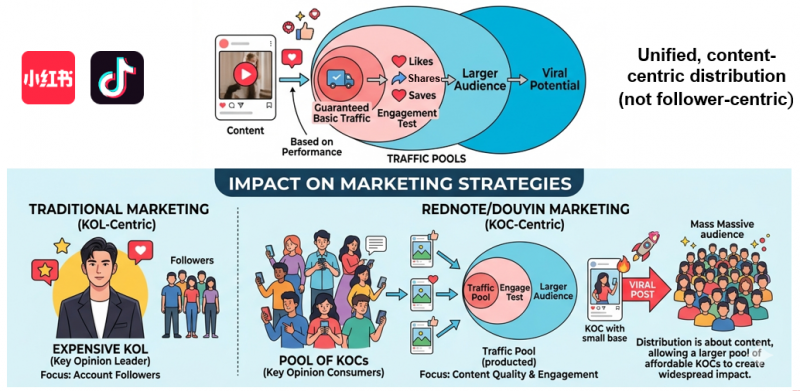
Dragon Trail’s 2024 KOC sales campaign for Disneyland Resort California shows the effect of this trend in action – by working with 100 KOCs, focusing on lifestyle and family bloggers, we reached an audience of more than 8 million, increasing ticket sales on Chinese OTAs by a minimum of 16%. Click here to read more about the campaign.
3. Market fragmentation and the rise of new influencers
Dragon Trail’s consumer research has shown that influencer content has a bigger impact on destination choice than content from official tourism board or embassy channels, and influencers are able to share content across more social media platforms than a tourism brand typically can. But destinations and brands will have different objectives for their influencer marketing, from targeting niche demographics to growing overall brand awareness, so there are many different approaches to influencer marketing that brands can take.
The Chinese outbound tourism market is increasingly fragmented and diverse, and brands will want to optimize their marketing by targeting the right segments and demographics to match their products or destination. This also means choosing influencers that will be most effective in reaching those markets, such as silver travelers or family travelers.
Another major trend in Chinese outbound travel now is the exploration of niche interests through travel, with a move away from generic group tours and towards very personalized, customized itineraries. By working with niche influencers who focus on very specific topics – such as astronomy or classical music, brands can tap into this trend and also access followers who are more engaged and stickier. Some influencers are also now known as KOSs, or “Key opinion sales” and specialize in selling travel products directly to their followers – working with these kind of influencers can be a good choice for travel businesses such as hotels or cruise lines.
4. Seeking authenticity, users turn to “anti-polished” content
Another trend on Chinese social media is a new emphasis on authenticity – real people doing real things, with real, practical suggestions. This ties into the importance of user-generated content, which makes up 90% of the content on RedNote. Chinese social media users are also tired of perfect, unattainable aesthetics and increasingly drawn to raw, authentic “anti-polished” (反精致) content.
One way that brands are creating more authentic – and cost-effective – marketing content is by leveraging employees. For example, AirAsia received high engagement on RedNote in 2024 for short videos about its cabin crew’s daily lives. These short videos, filmed by the crew using their own phones, feel more intimate to the audience than professionally shot content, helping to create a friendly image for the airline.
In the retail sphere, individual branches of a large chain may be encouraged to open their own social media accounts – the number of followers of each account will be smaller than for the main brand account, but together the numbers add up. The posts are more localized and feel more authentic coming from just one shop, and therefore receive higher engagement.
The decision by brands to work with KOCs rather than KOLs is similar to individual shop branches running their own social media accounts – the reach of a KOC is smaller than that of a KOL, but the results can actually be better because the audience is more targeted and engaged, and the content is perceived as more authentic.
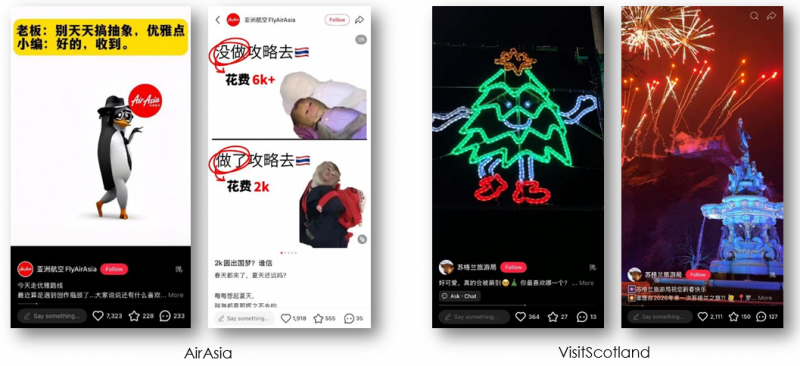
The push for authentic content is also related to the success we’ve seen during the past year with content that is seen as “low-effort” – designed to appear raw, spontaneous, and highly relatable. Rather than relying on polished destination advertisements, in 2025, AirAsia shared viral memes popular in China, such as a dancing penguin joking about creative burnout and a fainting monkey sticker commenting on travel overspending – both deeply rooted in Chinese internet slang and visual culture. These two posts collectively generated over 10,000 engagements, largely because AirAsia departed from traditional corporate formality and adopted a tone resembling that of a chronically online friend.
We’ve also seen this trend in our own management of VisitScotland’s RedNote account. At the end 2025, one video that performed especially well was just a short clip showing cute Christmas lights on a Scottish street. A video of 2026 New Year’s Eve fireworks in Edinburgh, which looked like a totally unprofessional video shot on someone’s phone, received thousands of likes. The accompanying text for the posts was written in colloquial, conversational language, which made it feel intimate and like authentic travel sharing rather than official promotion.
Dragon Trail offers social media management and influencer marketing services for international tourism brands in China, alongside travel trade marketing, event management, research and strategy consulting, market representation services, and public relations. Learn more here, and contact us to discuss how we can help you establish and grow your China market outreach.
Los fantásticos socios con los que colaboramos






Suscríbase a nuestro boletín gratuito para mantenerse al tanto de las últimas noticias
NO COMPARTIMOS SU INFORMACIÓN CON TERCEROS. CONSULTE NUESTRA POLÍTICA DE PRIVACIDAD.
This website or its third party tools use cookies, which are necessary to its functioning and required to achieve the purposes illustrated in the cookie policy. If you want to know more or withdraw your consent to all or some of the cookies, please refer to the cookie policy. By closing this banner, scrolling this page, clicking a link or continuing to browse otherwise, you agree to the use of cookies.